

Concerns about health risks, including links to gynecological tumors and uterine cancer, are driving a shift in Black hair care away from chemical relaxers.
COLUMBUS, Ohio — If there was ever a place to embrace change, it would be a hair salon.
As a hairstylist for almost 40 years, Karen Hill has had a chair-side view of the ever-evolving state of Black hair care.
“When I started doing hair, everybody’s hair was chemically. They had relaxers…the more we relaxed it, the more it fell out,” she said. “Then it got to the point where the only styles you could wear is a pixie–[like] Anita Baker [or] Halle Berry.
Their signature styles are born out of damage done in an effort to keep their hair straight.
But eventually, the toll it took had Hill and her clients feeling anything but relaxed.
“Every time I relax it, the third-degree burns and all that, I was over it. I did not enjoy putting relaxers on here and they were burning. I’m like ‘We need to go to the hospital. This seems dangerous.’ So one day I just stopped,” Hill said.
No longer relaxed
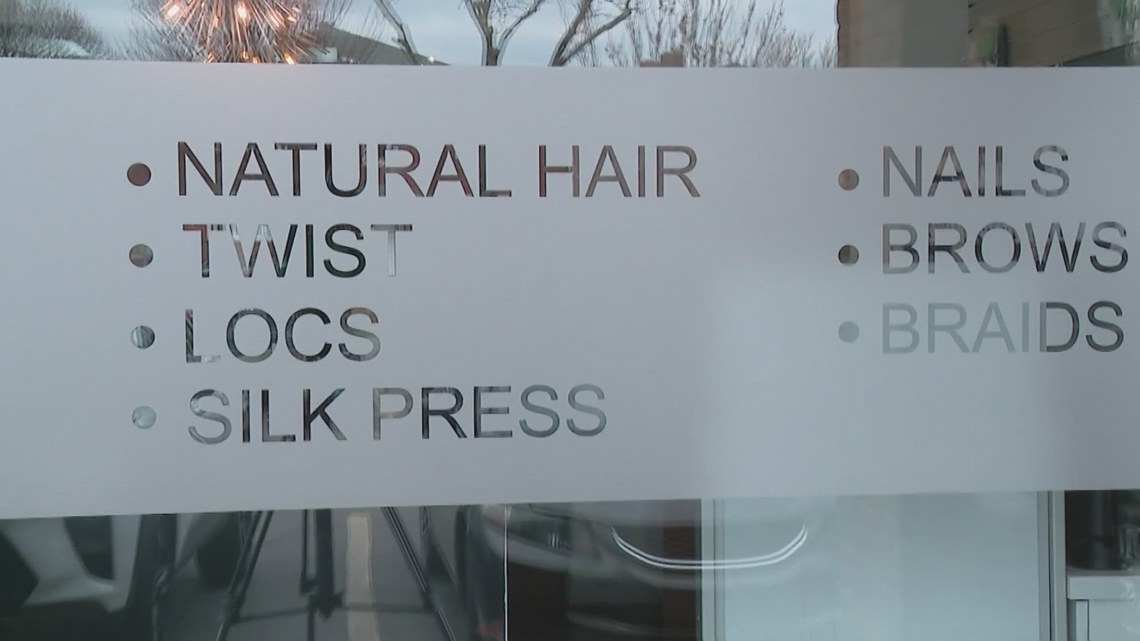
Hill opened her business, Synergi Salon, on the east side of Columbus in 2008. She made the decision to stop offering relaxers in 2010.
It was a risky business move for a new venture that paid off.
“A lot of my customers just stayed on board,” she said.
Hill credits the then-budding natural hair movement.
“The YouTubers talked about how to go natural,” she said.
And it’s a movement Columbus dermatologist Shari Hicks-Graham says could be saving lives.
“They’ve actually found that women who relax their hair more than four times a year perhaps may have an increased risk of gynecologic tumors and so really this study was quite interesting,” she said. “I still believe that a relaxer-free style is probably best for most people.”
What’s next
Through her haircare brand LivSo, Hill hopes that the future of Black hair care will include Black women investing more in the health of their scalp.
“A lot of people suffer with dry, itchy scalp, and they also may have a drier hair type. And the challenge is that oftentimes the dandruff shampoos that you can get over the counter or by prescription really are very drying and harsh and that can be just miserable if you already have a drier hair type,” she said. “So LivSo helps to normalize that and help to relieve the dry scalp and also respect the quality of natural hair.”
It’s a message Hill has also preached to clients through her book and product line.
“It gives a light feeling where we [are] used to like heavy products and feel[ing] weighed down,” she said.
And while she doesn’t quite know what the future of Black hair care holds, Hill hopes the lessons learned will lead the way.
“I don’t know what kind of robot hair is coming next, but something is coming, and I don’t know if it’ll cycle around to chemicals again,” she said.
Pending mass lawsuit
This comes as thousands of women across the country are participating in a multidistrict litigation (MDL) against major haircare brands. They claim their “straightening” products are making them sick.
Four of those cases are connected to women in Ohio.
It’s an issue that’s also been the topic of several major health studies– including the “Sister Study.” It was published by the National Institutes of Environmental Health Sciences and followed thousands of women for over a decade.
The study found that those who used “chemical relaxers” more than four times a year were more than twice as likely to develop uterine cancer than those who didn’t. And they’re products that have been advertised heavily to Black women.
This post was originally published on this site be sure to check out more of their content.