



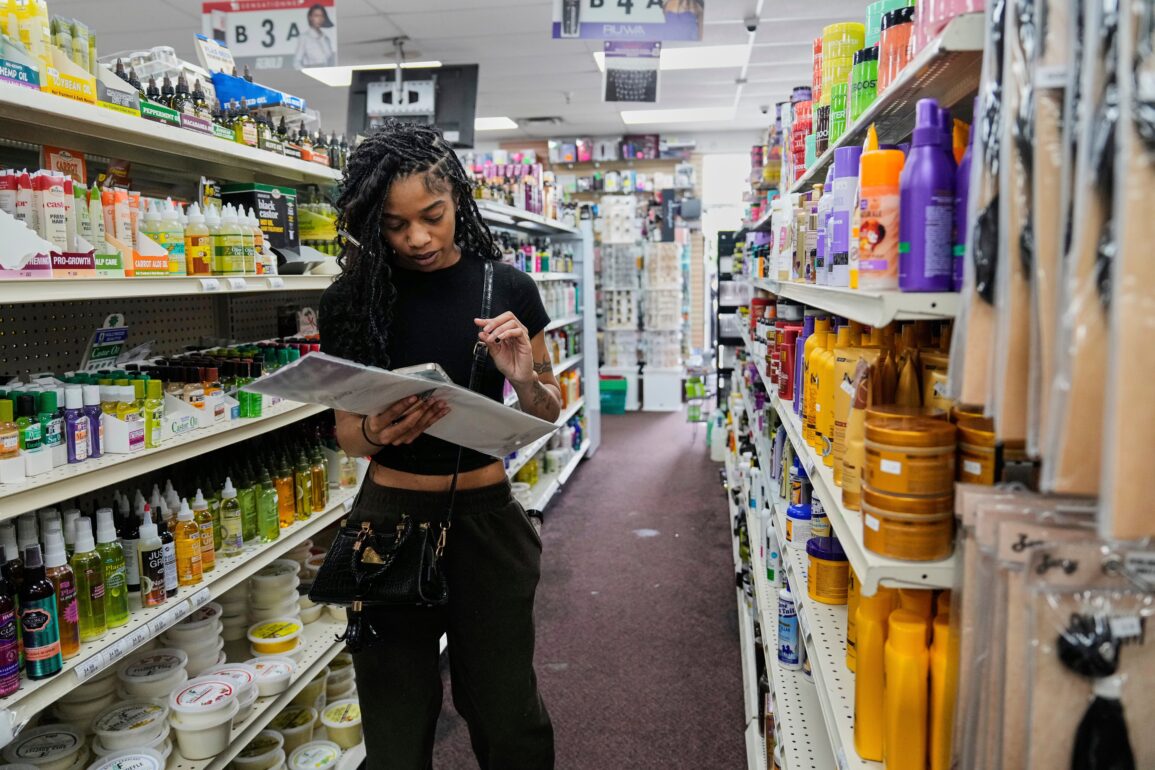
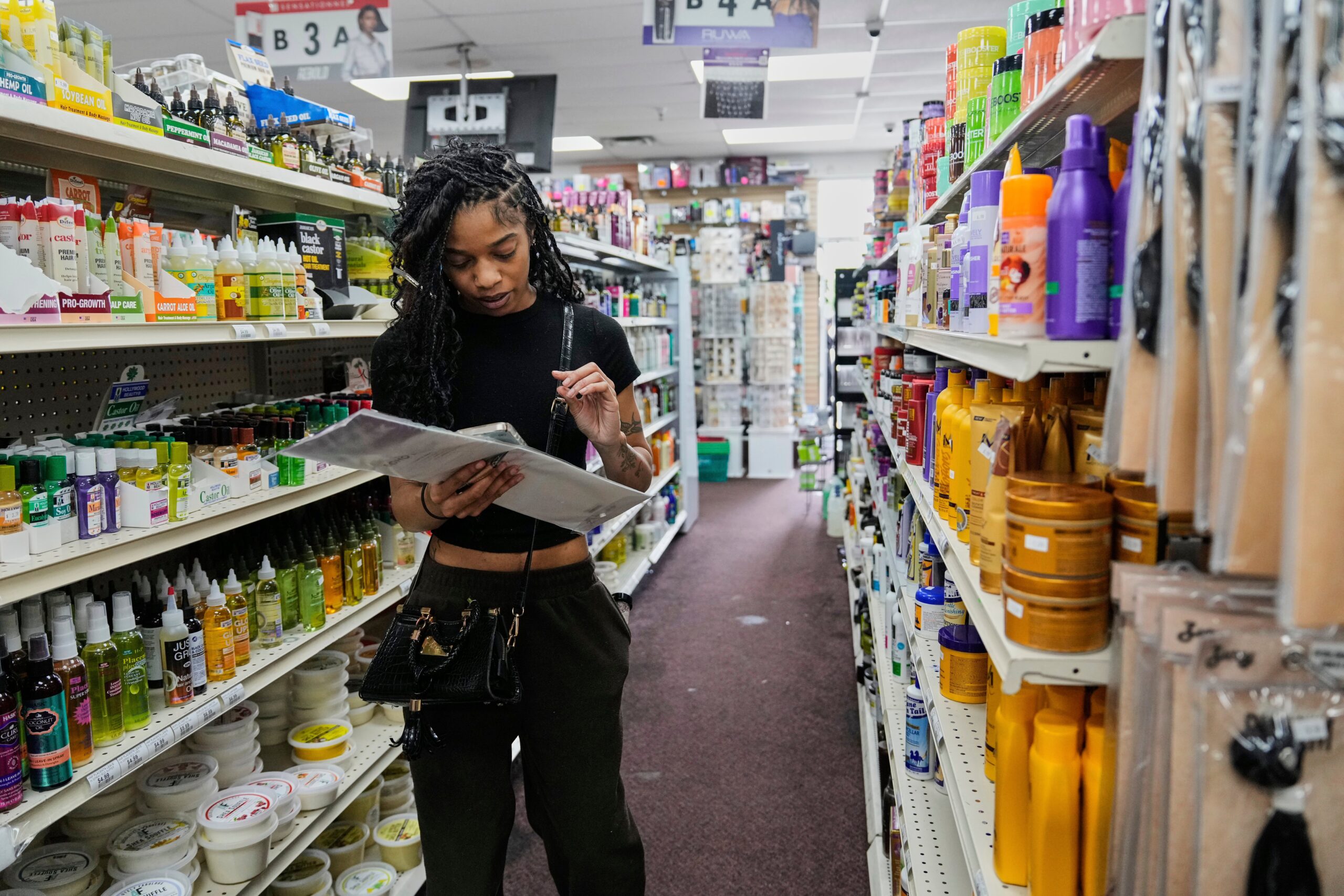
Janice Lowe, who runs 5 Starr Salon in a lower-income neighborhood southeast of Atlanta, has started asking clients to bring hair and is unable to purchase certain products.
“I’m falling behind on my obligations,” she said.
The industry braces for uncertainty
Consultants vary on how much prices will rise, when they’ll go up and for how long — and the full harm to stylists and consumers could be months away.
The global Black hair care industry was worth about $3.2 billion in 2023, according to market.us, and Black women spend six times more on hair care than other ethnicities.
Stylists often purchase some harder-to-get professional products from door-to-door distributors that buy from wholesale companies or larger distributors that purchase directly from other countries.
Lowe has seen some of her distributors vanish altogether, making it harder to get professional lines such as Black-owned leading professional hair care brand Design Essentials, manufactured in Atlanta at McBride Research Laboratories.
Design Essentials is trying to delay big price increases until 2026 or 2027, and may turn to layoffs or pause promotions to save money, said president Cornell McBride Jr. Most packaging plastics come from China, but ingredients can come from many places.
“Nobody wants to put it to the consumer but the person who pays is the consumer in the end,” McBride Jr. said.
Hawa Keita and her mother usually charge customers between $160 and $250 for braiding at their shop, Eve’s African Hair Braiding in College Park southwest of Atlanta. Keita is determined to take losses because their customers “can’t afford the Atlanta prices,” Keita said.
The cost of a box of 100 packs of braiding hair from China went up for the first time in two years, from $250 to $300, Keita said. They order weekly, often multiple boxes. Some companies say they’ll soon raise prices or run out of stock.
Making customers happy is ultimately what will keep the business afloat, Keita said. She smiled as she recounted braiding a young woman’s hair for her birthday with a style she suggested.
“When we finished, she gave me the biggest hug, and she was in here screaming and just yelling because she just really loved her hair,” Keita said.
Priced-out consumers face unfair beauty standards
For many Black Americans, especially women, affording their hair care also means confronting unfavorable beauty standards. Georgia State University law professor Tanya Washington said recent discoveries about dangerous chemicals in synthetic hair and hair straightening products have sparked conversations among Black women looking for hairstyles that don’t require as much imported products.
But embracing natural hairdos can be daunting for women like the soon-to-be lawyers and clerks Washington advises who face pressure to straighten their hair.
“That puts everyone who does not have organically, naturally derived straight hair at a disadvantage in these spaces,” she said. “I think that a definition of professionalism that favors one phenotype — European phenotype — over all others, is inappropriate.”
Longstanding income disparities between Black and white American women can also make higher hair care prices untenable. According to the U.S. Census, as of 2023, the median household income in Atlanta is $131,319 for white households and $47,937 for Black households.
It’s an inequality issue that professional hairstylists are aware of nationwide.
Stylist Mitzi Mitchell, owner of PIC ONE Beauty Services in Pennsylvania, said she has stocked up on certain products and tools for another year in anticipation of price increases.
She wants to avoid “bootleg” products, which are made illegally and often aren’t as safe, but became much more prevalent in the marketplace during economic downturns.
“I’m really conscientious about my Black minority clients because we make a heck of a lot less than other nationalities,” said Mitchell, who is Black. “I try to keep prices low so we can continue to have the same services, but I know I will have to raise it.”
By CHARLOTTE KRAMON Associated Press/Report for America
Subscribe to Closing Arguments
Sign up for new weekly newsletter Closing Arguments to get the latest about ongoing trials, major litigation and hot cases and rulings in courthouses around the U.S. and the world.
This post was originally published on this site be sure to check out more of their content.